Went to the supermarket (nearest eight miles) yesterday. Came out, loaded the shopping, got into the car and started to drive out of the car park when I saw something on the windscreen. Stopped, got out, had a look and discovered what I believe was a harliquin ladybird - black body with two red spots and white spots each side of the head. Guess what - no camera, no glasses, no magnifying glass, nothing to catch and carry it in - brilliant!!! For the eight miles drive home it stayed glued to the windscreen and I had visions of being able to get the camera and get the required image but when I stopped and parked the inevitable happened it 'legged it' or should I say 'winged it'!!!
However a few days ago I did manage two shots of a two spot ladybird. The first was in the garden privet hedge and from there it promptly decamped to the patio table and as I took the photo it vanished into thin air!!! Some you win - I was going to say some you lose but I am not so sure at the moment as I managed to get a couple of pics of a strange 'bird' crossing the garden this afternoon. It was preceded by five youngsters' but inevitably I was too slow to get my hands on my camera. As I said earlier some you win and .....
..
.
Tuesday, 5 June 2012
Sunday, 29 April 2012
Lizards.
A few days ago I was moving trays of seedlings from a coldframe when my eye caught a movement but I did not see what caused it. I left the top of the frame open and shortly afterwards when I was passing I saw this lizard which apparently was trying to find a spot in the fitful sunshine. It gave a good impression of trying to hide but nothing compared to "I'm watching you watching me" in the next image.
In the ten years my wife and I have lived here we have seen colonies (I dont know if there is a collective noun) of lizards in the garden - they seem to particularly relish the limestone of this area.
These are some of the sightings over the years. The first image is apparently a pregnant female on top of a hebe shrub seeking the sunshine.
Lizards are known to shed their tails when in danger and I believe the next three images illustrate how they grow a replacement.
The last two images are juveniles.
They are fascinating creatures and provide endless enjoyment providing that they get what we all want - sunshine!!!
Thursday, 19 April 2012
Digger wasps?
My daily walk with 'the boss' takes me along a farm track which in dry weather becomes very compacted with the daily use of heavy tractors and farm machinery. I dont know how to describe the ground other than that with wet weather it becomes thick clinging mud only to dry to a rock hard surface when it dries out. Year in year out I find these small mounds and burrows in a particular length of the track. I have never been fortunate enough to see the occupants but researching the matter I think that they are digger wasps and possibly ammophila sabulosa or hinderius albilabris until somebody tells me otherwise!!! I found these particular burrows at the beginning of this month. Needless to say with the present heavy rain and tractor use they no longer exist and so I will have to wait for when (or if) the sunshine returns.
Wednesday, 18 April 2012
Sorry state of affairs.
Earlier today I went for my usual walk with 'the boss' - terrible weather with rain and wind. Sad to say I found the severed head of a young fallow stag. No photo. No further comment.
Deformities of Birds.
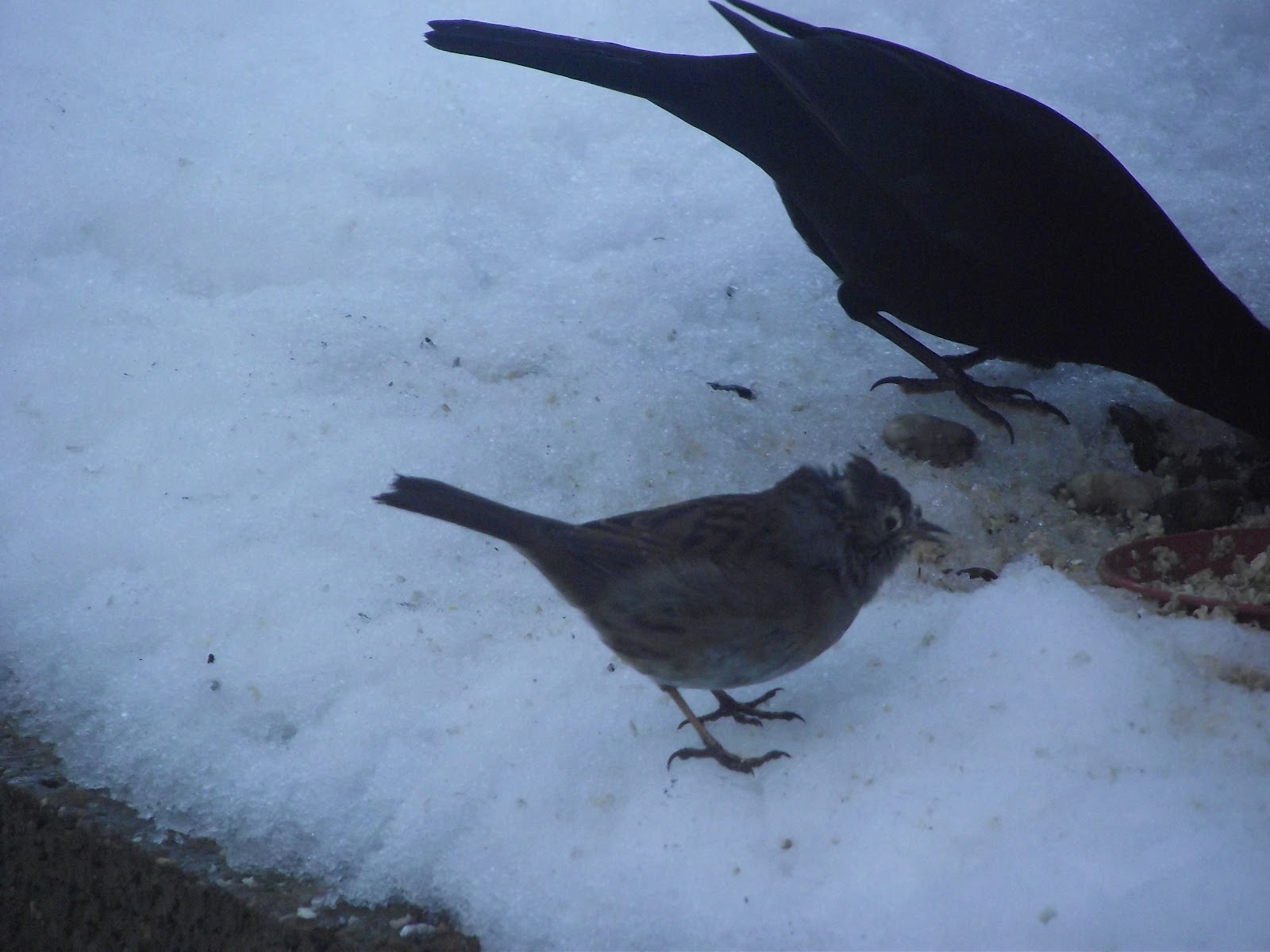
During the autumn and winter months my wife and I noticed a rather large number and variety of birds with various deformities and diseases but it proved impossible to get decent photographs. The magpie featured in my previous post is incapable of using it's legs - simply using it's breast to land and perch (it is still surviving today). The great tit was only seen once - it had a large growth on the side of it's face and seemed incapable of turning it's head. At least two dunnocks were seen with head deformities and soon vanished from the scene. Two partridges were seen - one had a large lump/growth to the rear of it's left eye partly obscuring it. The other one had some sort of deformity on top of it's head. Blackbirds also featured with top of the head baldness and some sort of scaley growth. Chaffinches were prominent with scaley leg growths and one I nick named 'helicopter' because it's legs seemed so painful that it had to hover to gently lower itself to the ground. Finally when the fieldfare appeared I did not give much for it's chances - it tucked itself away for a couple of days. Eventually we managed to coax it out to partake of apples. Over a period of five days it seemed to recover it's strength and flew away.
Tuesday, 17 April 2012
Bombylius major.
A few days ago on a very cold morning my wife found this bee fly lying in gravel in a torpid state but after a few minutes there was slight movement so we moved it into a sunny spot. Sometime later it had recovered and flew away.
Saturday, 7 April 2012
Can anybody help?
?
On 14th March this year I took my usual walk with 'the boss' and as usual we stopped at the far end of the walk. It was a foul day - foggy with a fine drizzle and very poor visibility. I was looking north when I became aware of a bird flying towards me on a line east to west. It flew over me and landed on top of the only tree in the vicinity. I could not readily identify it - it appeared smaller than crow and did not show the characteristics of a jackdaw. The head appearance has that of the corvid family. After hesitating I decided to try for a photo and managed six poor(very) shots and because of the distance I tried to edge towards it but with the inevitable result - it took flight westwards. Because of the inclement weather and the fact that I only had a compact camera I did not bother to check the images until a later date. There is very little detail to help identification but I am curious about the bar? on the right wing. Can anyone help with any information please?
Outcast.
.
This magpie has been with us for about two weeks during which time it has been difficult to work out what is wrong with it. It is very alert and rather averse to the human form and any sign of a camera. There are at least twelve other magpies in this vicinity and they all ostracise it. I have to admit that they are a beautiful bird with a cunning intelligence but I do not like them because of their liking for the eggs and young of songbirds. Already this spring they have taken the contents of the nests of a pair of blackbirds and a pair of chaffinches. This particular bird appears to have no use in it's legs and is possibly short of one foot. It has to 'belly flop' to land and perches on its stomach - when taking off it's are not in evidence. The best image I have been able to photograph the bird resting in a tree(still very poor). I'll keep trying but as stated earlier it is very alert as it needs to be with the ever threatening presence of the resident sparrow hawk.
Sunday, 18 March 2012
Back in Harness(3)
Hopefully all problems now resolved I can get back to blogging. I am probably going to change direction slightly and my intention is to outline that in my next post so please stay with me.
Friday, 18 November 2011
ProStalk camera.
Last year I reported that I had purchased a ProStalk camera which gave very good results for some ten months and then started to malfunction. I decided to upgrade to a ProStalk PC 5000. This camera has given very good results and I am showing just two here. The first is simply to illustrate the problem with magpies which are reponsible in my area for the loss of numerous song birds'nests. The second one I found very interesting in that I was puzzled by the fox staring at something. I believe that I have now solved the mystery and I will show that result in a later post.
Labels:
fox,
magpies,
ProStalk camera,
song birds' nests.
Wednesday, 16 November 2011
Swallows
For many years at least two pairs of swallows each raised one, two and sometimes three broods each year in my neighbour and friend's garage. Sadly he passed away in April three years ago - apart from a cursory visit the swallows did not return to the garage. It was the same story in 2009 and 2010. We live in a very rural area and it was noticeable that there was no reduction in the number of swallows flying around the area culminating in families congregating on overhead cables at the end of the season. In late March and early April this year it was a completely different scenario with quite a number flying in and out of the garage in what can only be described as 'excited anticipation' and happily 'chattering away' to each other - the attitude was completely different to that of the previous three years. Unfortunately due to my wife's illness I was not able to monitor their activities but at the end of July I was able to get a quick photo literally minutes before the brood of four fledged. To the right of this nest there is a second but at the time of the photo there was no sign of any activity - nineteen days later another brood of four fledged. A story tinged with sadness and happiness which raises a number of questions to which I have no answers.
Sunday, 4 September 2011
Sparrow hawk
On the last day of the last cricket test match my wife shouted from the dining room "come here, quick". Leaving the tv I went to her and saw that she was pointing to something outside the window and grabbed my camera which was close by. It seems that the bird had crashed into the window rather heavily and was perched on a wall close to the window. It was obviously disorientated and confused. I managed eight pics(one was blurred) leaving me these seven.
Baack in harness(2)
My wife has endured over five months in hospital and has survived two major operations and a massive heart attack - happily she is now back at home but facing a long period of recuperation. One brave, courageous lady. Hopefully I can now resume blogging but keeping a watchful eye on her. She has had a long interest in bats and is now pursuing that interest with our one hundred plus colony.
Monday, 14 February 2011
Big Garden Birdwatch.
This year's count compared with the previous four.
Column (a) 28.01.07.
Column (b) 27.01.08.
Column (c) 25.01.09.
Column (d) 31.01.10.
Column (e) 30.01.11.
(a) (b) (c) (d) (e)
Blackbird 7 2 4 4 7
Blue tit 10 12 9 5 11
Chaffinch 7 7 6 11 6
Coal tit 0 1 2 1 2
Collared dove 2 7 5 3 5
Dunnock 5 3 2 3 5
Great tit 13 14 8 6 12
Greenfinch 9 16 10 7 4
Goldfinch 8 11 13 12 12
House sparrow 14 17 7 14 14
Long-tailed tit 0 8 12 10 12
Magpie 2 4 1 0 0
Robin 6 6 4 3 4
Starling 0 0 0 0 6
Woodpigeon 2 0 2 0 0
Bullfinch 2 0 2 0 2
Tree sparrow 9 3 2 2 5
Song thrush 1 0 1 1 0
Fieldfare 15 0 0 0 7
Redwing 11 0 0 0 3
Pheasant 1 1 1 5 1
Wren 2 0 1 1 1
G.S.woodpecker 2 2 2 2 1
Goldcrest 2 0 0 0 0
Sparrow hawk 1 1 1 0 0
Brambling 2 0 2 3 2
Siskin 2 0 0 0 2
Linnet 4 3 0 0 0
Marsh tit 1 1 1 1 1
Willow tit 0 0 0 0 1
Crow 0 0 2 0 0
Kestrel 0 0 1 0 0
Blackcap 0 0 0 0 1
Greenfinch figures give cause for concern but this fact has been well ducumented over recent years. Whilst my figures do not show any feeding station numbers decline I am concerned about numbers over the last two years in my area, where long-tailed tits are concerned. Upto autumn 2009 on a daily basis I was seeing in the region of 40 to 45 early morning as they worked their way along the railway embankment and again late afternoon as they made their return journey(no pun intended!!!) Each time perhaps a dozen would divert to the feeding station staying for a few minutes before rejoining the tailend of the main group. During autumn and winter months three or four families will combine feeding/ roosting together. During the last two winters I have not seen these family groups. The long-tailed tit is one of my favourite birds and I am fascinated by the way they continually 'chatter' to each other - they are a very sociable bird and I have never seen them resort to fisticuffs unlike goldfinches who are regularly quarrelling for example.
Column (a) 28.01.07.
Column (b) 27.01.08.
Column (c) 25.01.09.
Column (d) 31.01.10.
Column (e) 30.01.11.
(a) (b) (c) (d) (e)
Blackbird 7 2 4 4 7
Blue tit 10 12 9 5 11
Chaffinch 7 7 6 11 6
Coal tit 0 1 2 1 2
Collared dove 2 7 5 3 5
Dunnock 5 3 2 3 5
Great tit 13 14 8 6 12
Greenfinch 9 16 10 7 4
Goldfinch 8 11 13 12 12
House sparrow 14 17 7 14 14
Long-tailed tit 0 8 12 10 12
Magpie 2 4 1 0 0
Robin 6 6 4 3 4
Starling 0 0 0 0 6
Woodpigeon 2 0 2 0 0
Bullfinch 2 0 2 0 2
Tree sparrow 9 3 2 2 5
Song thrush 1 0 1 1 0
Fieldfare 15 0 0 0 7
Redwing 11 0 0 0 3
Pheasant 1 1 1 5 1
Wren 2 0 1 1 1
G.S.woodpecker 2 2 2 2 1
Goldcrest 2 0 0 0 0
Sparrow hawk 1 1 1 0 0
Brambling 2 0 2 3 2
Siskin 2 0 0 0 2
Linnet 4 3 0 0 0
Marsh tit 1 1 1 1 1
Willow tit 0 0 0 0 1
Crow 0 0 2 0 0
Kestrel 0 0 1 0 0
Blackcap 0 0 0 0 1
Greenfinch figures give cause for concern but this fact has been well ducumented over recent years. Whilst my figures do not show any feeding station numbers decline I am concerned about numbers over the last two years in my area, where long-tailed tits are concerned. Upto autumn 2009 on a daily basis I was seeing in the region of 40 to 45 early morning as they worked their way along the railway embankment and again late afternoon as they made their return journey(no pun intended!!!) Each time perhaps a dozen would divert to the feeding station staying for a few minutes before rejoining the tailend of the main group. During autumn and winter months three or four families will combine feeding/ roosting together. During the last two winters I have not seen these family groups. The long-tailed tit is one of my favourite birds and I am fascinated by the way they continually 'chatter' to each other - they are a very sociable bird and I have never seen them resort to fisticuffs unlike goldfinches who are regularly quarrelling for example.
Wednesday, 9 February 2011
Garden Butterflies - 2010.
A list of the butterflies seen in our garden during 2010.
Small white
Large white
Brimstone
Orange tip
Green-veined white
Ringlet
Gatekeeper
Large skipper
Small skipper
Meadow brown
Painted lady
Speckled wood
Common blue
Holly blue
Red admiral
Peacock
Small tortoiseshell
Small copper
Comma
A modest list but nevertheless very pleasing to us.
Small white
Large white
Brimstone
Orange tip
Green-veined white
Ringlet
Gatekeeper
Large skipper
Small skipper
Meadow brown
Painted lady
Speckled wood
Common blue
Holly blue
Red admiral
Peacock
Small tortoiseshell
Small copper
Comma
A modest list but nevertheless very pleasing to us.
Thursday, 20 January 2011
Fallow Deer (again!!)
This shot was taken on 27th December last when six fallow deer wandered passed or dining room window late in the afternoon obviously searching for food and they seemed to enjoy the haws and sloes lying on the ground under the bushes. It was a mad scramble to find my camera and get into a position without spooking them and I only managed three (possibly four) in this only remotely possible shot.
Yesterday five wandered passed again and as usual I was totally unprepared but managed three individual shots. In my defence it is obvious that I have not yet mastered the art of shooting at an angle through double glazing and at a distance from the window, to say nothing of avoiding sudden movement and preventing 'the boss' trying to get in the act - it certainly adds interest to the exercise!!!
What is it?
On Monday my wife was driving into town and spotted this object which we believe is from the fungi world. Later the same day I went to take two shots. It is about eighteen feet from the ground and appears to be growing from a long established hole in the trunk of an ash tree. My fungi knowledge is zero so much so that I would be reluctant to pick field mushrooms with any certainty!!
Monday, 10 January 2011
Happy New Year
to one and all - better late than never!!!
For as long as I can remember, with the advent of a new year I always look for signs of Spring - not for early or late seasons but simply to convince myself that Spring is on the way and Mother Nature has not forgotten us. It may be some weeks away but these signs do help to lighten the spirits and lift the gloom. The signs so far to name but a few - catkins on alder and hazel, buds on cherry trees and horse chestnut trees, birds starting to display in particular dunnocks and robins and blackbirds pairing. In the past I have found nests with eggs of blackbirds mid January but I dont think that will happen this year.
I have not seen any hares on my patch since last October but yesterday I saw two racing round a winter wheat field. However the highlight of the day was the sighting of eight buzzards circling overhead at a height almost beyond the vision of the naked eye.
All good signs for me but I readily appreciate that it will be a different story north and south of my patch. No pics on this occasion I'm afraid.
For as long as I can remember, with the advent of a new year I always look for signs of Spring - not for early or late seasons but simply to convince myself that Spring is on the way and Mother Nature has not forgotten us. It may be some weeks away but these signs do help to lighten the spirits and lift the gloom. The signs so far to name but a few - catkins on alder and hazel, buds on cherry trees and horse chestnut trees, birds starting to display in particular dunnocks and robins and blackbirds pairing. In the past I have found nests with eggs of blackbirds mid January but I dont think that will happen this year.
I have not seen any hares on my patch since last October but yesterday I saw two racing round a winter wheat field. However the highlight of the day was the sighting of eight buzzards circling overhead at a height almost beyond the vision of the naked eye.
All good signs for me but I readily appreciate that it will be a different story north and south of my patch. No pics on this occasion I'm afraid.
Thursday, 16 December 2010
Honeysuckle.
We have a marvellous hedge of honeysuckle and this year it has again produced a terrific show culminating in a mass of berries. I photographed the berries on 9th August and they were completely stripped by the end of the month mainly by bullfinches and blackbirds and one juvenile robin tried to help out!!! To give an indication of the amount of berries cconsumed - the hedge is about fifteen metres long and a metre high and wide.
Subscribe to:
Posts (Atom)